 HAVANA Jose Marti International Airport
Aeropuerto Internacional Jose Marti de La Havana, Cuba, HAV Airport 
|
|||
|
|
CUBANA Airlines
Mission and Values of Cubana AirlinesFrom the very beginning Cubana Airlines valued service and constant improvements. Its slogan sounds as Puerta de Cuba al Mundo (Cuba's Gateway to the World). It is written on the airline's site that it aims to perform not worse than competitors, be punctual, secure and efficient for coming and leaving passengers. This is the airline's mission. History of Cubana AirlinesCubana Airlines before the Cuban Revolution
International flights from Cuba started in May 1945. Cubana Airlines flew to Miami on Douglas DC-3 aircraft. In three years, in 1948, the airline began to perform transatlantic flights to Madrid making three stops on the route (Bermuda, Azores and Lisbon). Rome became the second point on Cubana's European route map. The company was the first from Latin American carriers to establish transatlantic scheduled services to Europe. Later Mexico City and New-York appeared in the airline's schedule. In April 1945 Cubana Airlines became a founding member of the International Air Transport Association (IATA) at a conference that took place in Havana. It also took part in creating of the International Civil Aviation Organization (ICAO) and the International Association of Aeronautical Telecommunications (SITA). Moreover it is a member of the International Association of Latin American Air Transportation (AITAL). By the end of 1955 Cubana carried over 227 000 passengers and the total number of its employees counted 715. Before Cuban Revolution Cubana Airlines exploited such aircraft as Douglas DC-3s, 4s, 7s, Bristol Britania 318s and Lockheed Constellations. Cubana Airlines after the Cuban Revolution
Collaboration with the Soviet government helped to start Moscow – Havana services in 1963. This was an 18-hour non-stop flight on board Tupolev Tu-114 jet-props aircraft. Cooperation with Eastern Germany made it possible to organize scheduled transatlantic services between East Berlin and Havana. In 1970-s Cubana Airlines enlarged its routs greatly. It began to fly to Central and South America, some Caribbean countries. Cuba started to develop its tourism sector, and new flights to Canada appeared on its route map. The airline also connected Havana with Angola, Guinea-Bissau and Cabo Verde in Africa. It even started services to Iraq, but soon the flights were ceased. Nevertheless Cubana became the first to perform flights from Latin America to Asia. In 1990-s the airline had serious problems with aircraft and spare parts for Soviet-build planes. That is why it decided to renew its fleet and buy several new generation aircraft again in Russia. This helped Cubana Airlines to continue performing flights to Europe, Canada and Latin America destinations. Modern History of Cubana Airlines
Nowadays the airline connects Cuba with more than 20 countries all over the world, mainly in Europe, the Caribbean, South, Central and North America. The number of destinations is constantly growing. Its fleet counts 20 aircraft. The headquarters of Cubana Airlines are located in Havana. The main hub is Jose Marti International Airport. It has subsidiaries in 7 European countries (France, Spain, Germany, Russia, Italy, Czech Republic and Serbia), in 7 countries of Asia and Africa (Turkey, Iraq, Zimbabwe, Libya, Israel, Ethiopia and Algeria). More than 13 representative offices of Cubana are situated in Central, South and North America. |
||
|
|
|||
|
|
|||
 Cubana Airlines, or in Spanish "Cubana de Aviacion", is the national and the oldest airline in Cuba. It started on October, 8 in 1929. There are three airlines in Cuba at present: Cubana Airlines, Aero Caribbean and Aerogaviota, but it takes the leading place among them. Its IATA code is CU, ICAO code is CUB and call sign is Cubana.
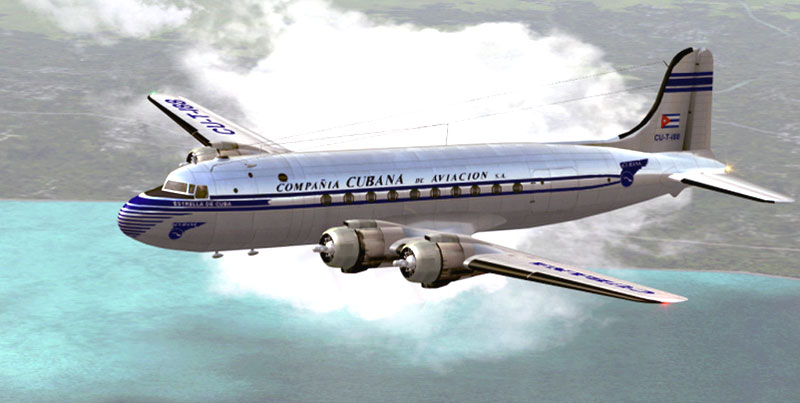 It was stated that Cubana Airlines was founded in 1929 and performed only charter flights. Scheduled flights began one year later, in 1930. They were domestic routs only:
Havana - Camaguey,
Havana - Guantanamo - Baracoa,
Santiago - Baracoa.
It was stated that Cubana Airlines was founded in 1929 and performed only charter flights. Scheduled flights began one year later, in 1930. They were domestic routs only:
Havana - Camaguey,
Havana - Guantanamo - Baracoa,
Santiago - Baracoa.
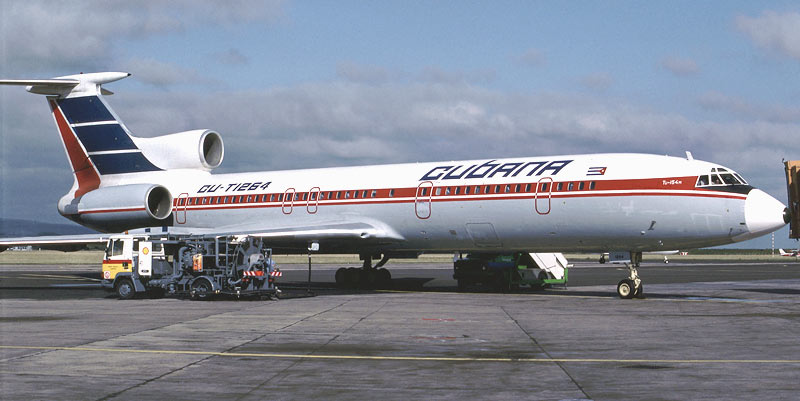 In May 1959 Cubana was reorganized. All investors were expropriated. Some privately-owned companies merged in Cubana Airlines, and the new government got 80 % of share holding. Renewed airline started operations in June 1691. Flights to the USA were canceled. But new routes to Europe appeared. And the first among them was Prague. During that period Cubana Airlines had to order aircraft in the Soviet Union. It got Ilyushin Il-14 and Il-18 to perform domestic flights. Later the airline got Antonov An-12 and An-24s.
 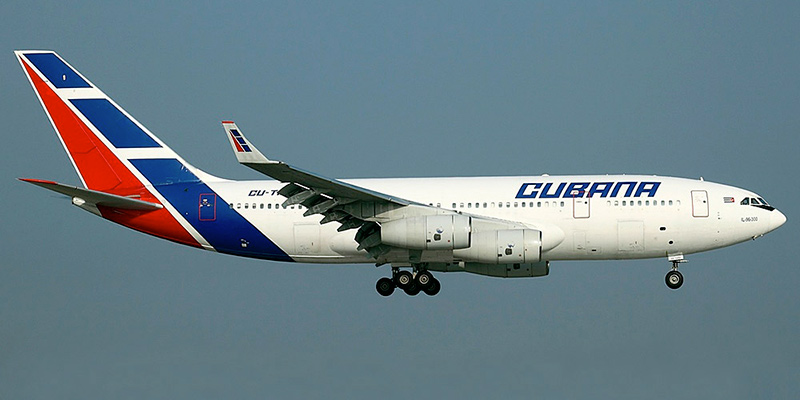 In 2005 Cubana Airlines created a joint venture with Iberia Airlines (Spain) in order to maintain and overhaul Airbus and Boeing airliners.